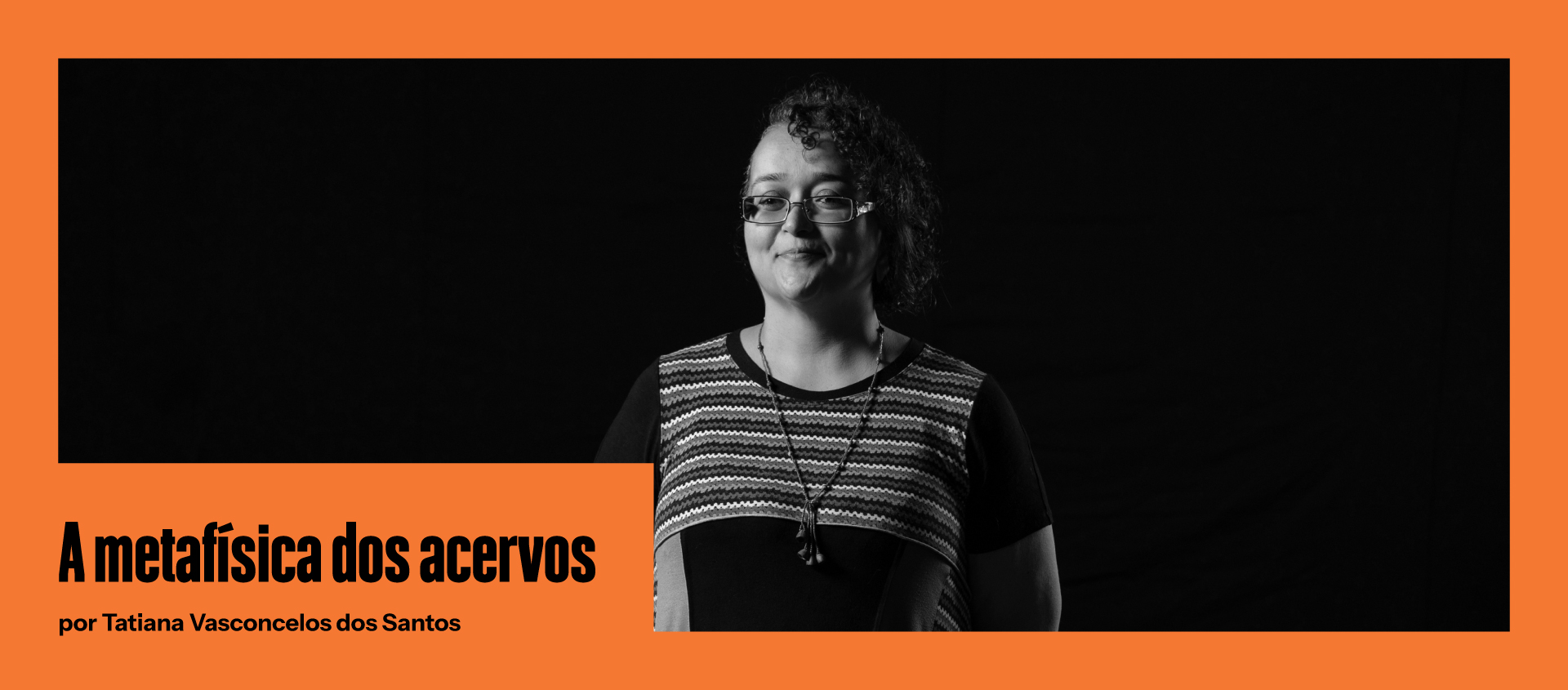
It was the first time I had set foot in the Museum after almost ten years of closure. When I entered the room where I used to work, transformed into an exhibition space after the renovations, I cried with emotion. It was as if I could see it exactly as it had been: the space of the documentation sector intended to receive researchers.
And so I was transported back to 2001, when I was still an intern, had just started working at the Museum, and saw that man entering the room.
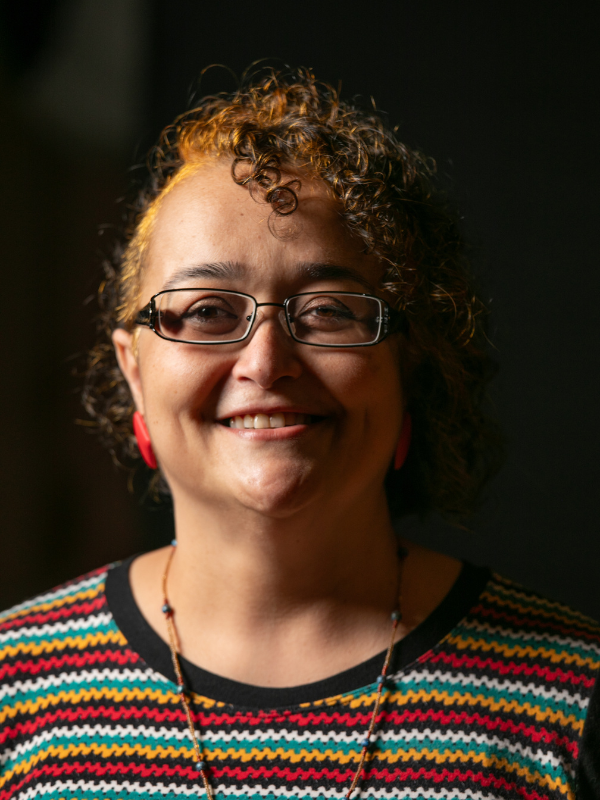
He introduced himself as the great-great-grandson of Benedito Calixto and said he would like to discuss a possible partnership, something related to a commemorative date.
My boss asked me to stay with him while she finished another task, and I immediately showed her the photos of his artist ancestor, which, coincidentally, I had been working on for days.
He sat down and, almost immediately, began pointing out who was who, what had become of each person who appeared in the photographs. "This one died, this one got married, this one..." – and so it went, as if those figures were all still among us, as if they were our contemporaries.
In those days, I had spent hours poring over that collection: checking which images already had print reproductions, separating them, organizing them, and giving them direction. A mechanical task that I was beginning to grow fond of, but which, that afternoon, took on a completely different dimension.
It was as if, suddenly, everything made sense.
I have a degree in philosophy, a field focused on concepts, the structuring of thought, and the rigor of logic. But during my undergraduate studies, I didn't see myself on that path; I couldn't imagine exactly what I would do or where I would fit in.
And then I arrived at the Museum. And there I found something concrete.
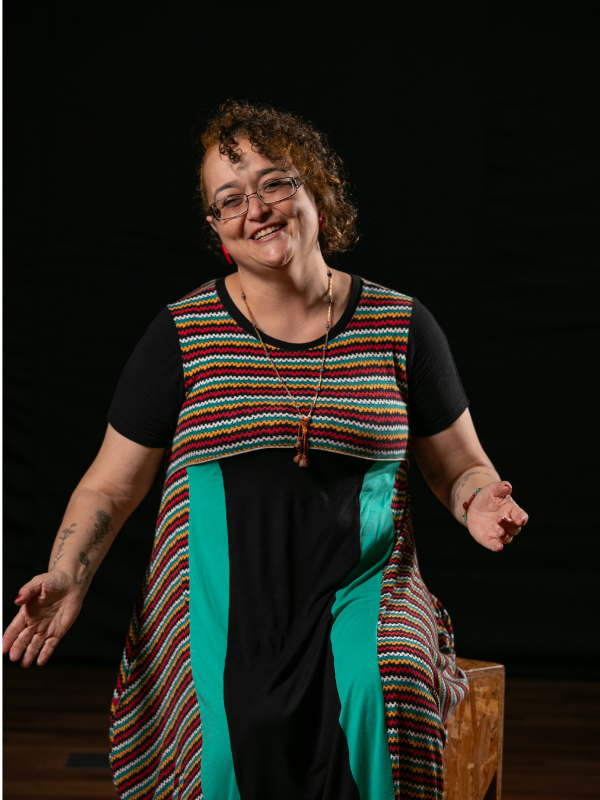
I realized that working with documentation was, fundamentally, about giving shape to things: organizing, cataloging, thinking about how information is structured, how it becomes accessible. But it was more than that.
There was something bigger, something that perhaps I began to perceive in that encounter with the descendant of Benedito Calixto. Something that I came to identify with the idea that memory is something tangible, within my reach, the physical matter of my work.
Then I knew. That was where I wanted to be. That's why that Friday afternoon, more than ten years ago, was so difficult for me.
We were in the middle of a meeting when a colleague from the communications department entered the room, breathless, and said that the building was going to close to the public.
This possibility had been on our minds for some time. But when it was confirmed, I was completely devastated. I thought that if the building was going to close to visitors, it would also close to researchers – and attending to those seeking information has always been an essential part of my work. I knew what the lack of access would mean for each research project.
But it got worse. On Saturday, I opened my email and found the news: the Museum would be closed to the public, to researchers – and also to us, the staff, who until then had worked inside the monument building.
I had just left a more reserved role, focused on inventory and cataloging, to take on the management of the entire collection, and now, suddenly, I was on the front line of decisions about how to deal with all of that, with all those memories.
For me, the most challenging part was shaping the change. Trying to understand where the documentation would go, what resources we would have. The inventory was already underway, but we lacked a more precise map, something that would tell us where everything was and, based on that, what kind of packaging and transport would be needed.
We didn't have time to plan the closure. Suddenly, we were outside the Museum, trying to decide what should (or shouldn't) remain inside.
It was the first time we would empty that building – and probably the only time. The discussions were long and exhausting. We didn't know where to begin: by typology, by area? And, in the midst of all that, questions arose that we hadn't even imagined.
We discovered, for example, that the building might not withstand uneven emptying and that it wasn't possible to remove everything from one side and then the other, as the weight couldn't change so abruptly.
It was precisely the closure of the Museum, and the kind of questions that a collection raises, that led the documentation to delve even deeper into the need to make the collection accessible remotely.
Years later, in the midst of the pandemic, we began migrating our database to Tainacan, a free and open-source platform developed for publishing digital collections.
While many museums choose to review everything and only make it available to the public when the cataloging is completely "closed," the Ipiranga follows a different logic: that of democratizing access. Thus, whenever possible, in order not to delay the sharing of data, we publish it as it is and then refine it. This inevitably means giving access to everything, including the problems.
Since migrating to Tainacan, our efforts have focused precisely on the continuous review of the cataloging of the last thirty years. When dealing with this data, we review inconsistencies and seek standardization, including in the spelling of names. At other times, when naming an object, someone suggests "trinket," and, as we work with controlled vocabularies, this term may not exist in the "listing." Before incorporating it, however, we open a discussion forum to understand if the term is appropriate, if there are more precise synonyms, in what contexts it applies, and so on.
In one of our metadata review meetings, a colleague questioned why we still only had the terms "man" and "woman" as descriptors for images. The question almost instantly opened a broader discussion about how this binary division no longer accounts for the complexity of our time.
They may seem like minor details, but they're not.
The collection is also a place of discovery, and research can often be someone's first contact with a universe far vaster than they imagine.
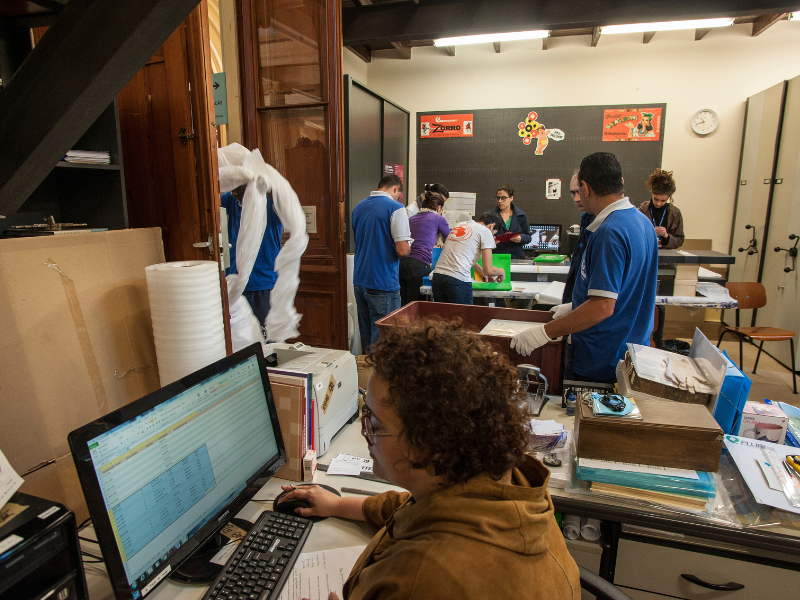
My role has always been between these worlds: that which documents and reflects upon the documentation, and that which emotionally understands each item and the research they inspire.
So many memories.
I remember the descendant of Benedito Calixto, but I also remember a little old lady who visited the Museum to consult architectural plans and brought back some seaweed leaves as a snack.
She would ask to access about fifteen plants at a time and would spend the entire afternoon like that: calmly observing the material, taking breaks, going out to eat her algae.
I didn't quite understand her criteria. She chose by color, and that irritated me a little, because the plants were enormous and required considerable physical effort to separate. Today I see it differently. I understand that she simply inhabited the Museum in her own way—and that, in the end, is something precious.
I don't know... My connection with the Museum is so intense that sometimes I feel like the collection speaks to me.
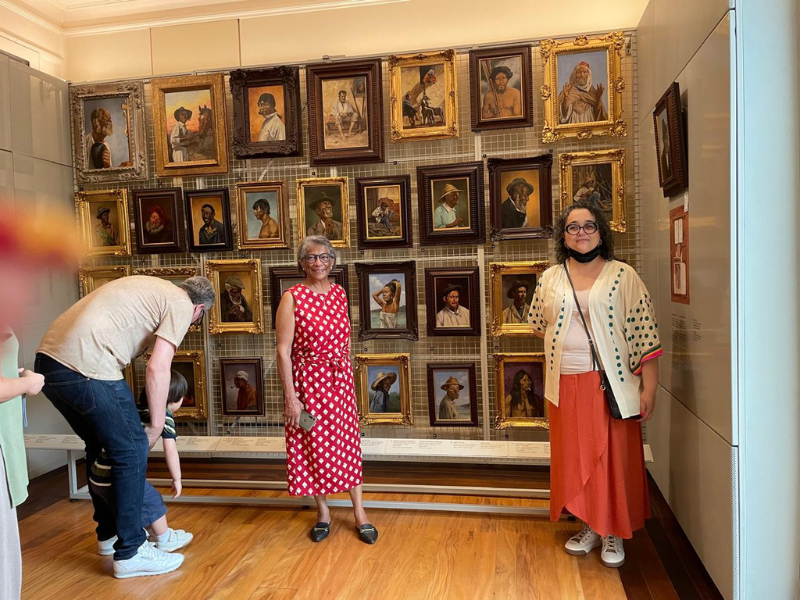
It happened one late afternoon when I needed to hold a conference in the technical reserve. It was around six o'clock, twilight, that time when reasoning loses its firmness, when thoughts begin to wander.
I was looking for a portrait when, suddenly, I had the feeling I heard a voice: "Hi.".
I was terrified. I closed the living room door and practically ran out the stairs, not even brave enough to wait for the elevator.
We are dealing with documents from a century-old museum – a collection made up of people who have been here before, and who, in some way, still remain.
Perhaps that's why I feel so small within this vastness of objects that continues to exist and that will still be seen by many other people in the future.
But I also understand that if the archive speaks, it's because someone listens to it and translates it. And that each description, each identified name, each organized piece of data is what allows these stories from the past to continue breathing into the future.