
They say there are two types of conservatives.
One circulates. He teaches courses and workshops, integrates research networks, participates in symposia, and publishes scientific papers. He is recognized, above all, for his ability to translate practice into discourse and to convert technical skills into shareable language.
The other remains in the museum. He is at the workbench, in the laboratory, in direct contact with the object. He undertakes a silent, invisible, almost nameless, but always manual job.
That's just how I am.
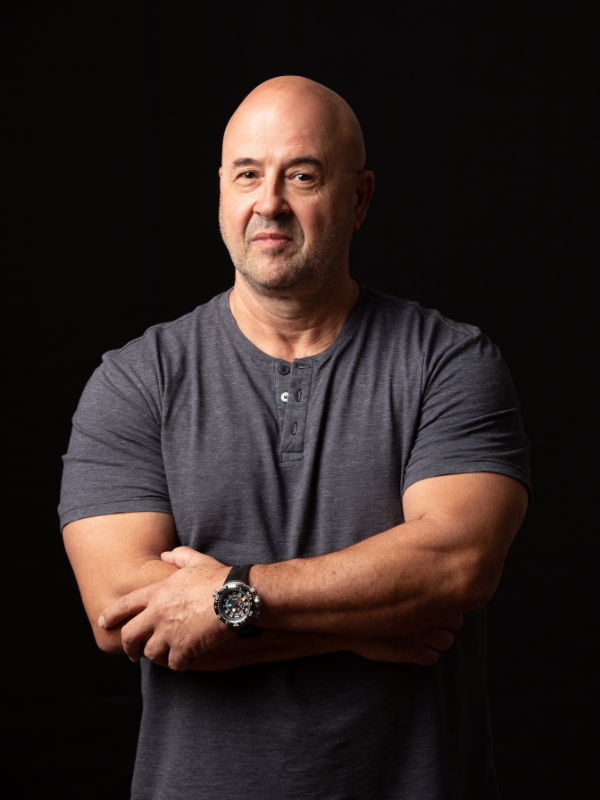
I've always been like that, actually. Since I was a child, my impulse has been the same: to open things up, take them apart, see what they were like inside. Toys, old radios, remote controls, any object that fit between my fingers and could be taken apart – and then put back together.
There was a fascination that never went away: this interest in direct contact with the material, in getting hands-on.
At the Museum, it was no different. I'm from Porto Feliz, a city located 20 kilometers from Itu. Because of this proximity, the Republican Museum has always been part of my horizon. I knew of its origin as the residence of the Almeida Prado family; its inauguration as a memorial to the Republic; and the collections related to presidents such as Prudente de Moraes and Washington Luís.
Even so, it wasn't the official story that led me there.
These were the restoration works.
The building had been listed as a historical landmark by IPHAN (National Institute of Historic and Artistic Heritage) and, in 1980, underwent a series of interventions to undo adaptations made throughout the 20th century and restore its original 19th-century configuration.
They were rebuilding alcoves, floors, walls, and ceilings. Within all of this, my contribution was quite simple: carrying books.
A friend called me for the job and I didn't think twice. It seemed easy to get paid just to help transfer the Prudente de Moraes collection – because of the renovation, the publications needed to be temporarily moved.
During that period, the city seemed to be riddled with construction. I don't know why, but other areas were also undergoing restoration. Since everything was close by, I frequently crossed paths with the restorers. They would call me over to see what they were doing, and I would go.
I spent entire afternoons following the restoration of the ceiling paintings at the Church of Our Lady of Mount Carmel.
That impressed me. But what truly remained wasn't anything grand. It was what fit in my hands:
Newspapers, books, and maps.
I loved to read. And my father always showed up with publications under his arm. Week after week, he brought back fascicles from Abril publishing house that I still remember: they were illustrated science notebooks, ranging from the speed of chemical reactions to the laws of motion, from atmospheric pressure to the workings of the most common things.
I read everything. No hierarchy. No choice.
I was very young, only 16, when I started at the Republican Museum, initially as an intern, after my experience carrying the Prudente de Moraes library. At 18, I was hired full-time and began frequently visiting the Ipiranga Museum because of the paper laboratory there. That's where I took the maps and books of Itu that needed restoration.
That's where I found myself. So much so that, two years later, when a permanent position opened up, I managed to get transferred there. I don't know, but I really enjoyed working with paper, and I had such an affinity for it that going back and forth to another city every day didn't even seem tiring.
I learned through direct contact with the material.
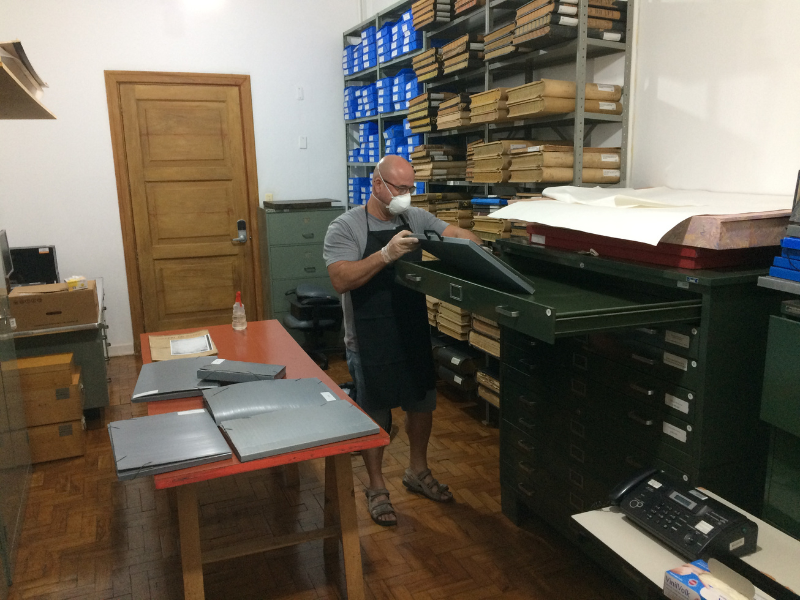
With mechanical cleaning, done dry, he removed what had accumulated on the paper; in aqueous cleaning, he allowed water to enter in a controlled manner to loosen the dirt without compromising the structure; and, in the case of grafts, he replaced what was missing with another carefully adjusted paper, until the intervention itself disappeared.
These were procedures of continuous attention, assimilated through gesture and repetition.
In the beginning, I enjoyed opening old newspapers and finding news from another era, still intact on the surface of time.
In caricatures, Prudente de Moraes appeared out of step, seated in wobbly chairs, as if seeking balance amidst the tensions that plagued his government. In newspapers, however, faced with the "threat" of the Canudos War, Prudente's name was a guarantee that the country remained standing.
Over time, however, it became clear that he could not sustain this pace, because if he read everything, the work would come to a standstill.
And in doing so, my interest expanded to other areas. I took a carpentry course, learned welding techniques, and many other manual skills. And the learning naturally entered the Museum: with adjustments to display cases, interventions in exhibition supports, assembly and disassembly.
Around 2004 or 2005, there was an exhibition with a series of toys, and I was called in at the last minute to help with the setup. Everything was behind schedule; there was an installation with EVA foam sheets on the floor, and nobody could cut the pieces at the right angle. So I went, and quickly solved the cutting problem.
As for restoring paintings, I never progressed very far. I did some simple things, like fixing a work to a frame, or even producing the support myself. But retouching, I never dared to do. On a canvas, there's always some pictorial layer that needs to be recomposed, and it's an adjustment that requires mastery of color, and I don't feel at all comfortable doing that kind of intervention.
Ultimately, working with paper has always been what interested me most – it was where I felt most at home. In 2006, however, I had to return to Itu. For many years, I commuted between São Paulo and Porto Feliz every day, but with the birth of my daughter, the routine became impossible, and I had no choice but to request a transfer.
I remain one of the longest-serving employees. At both the Republican Museum and the Ipiranga Museum, there are only two people ahead of me: one with 50 years of service, another with 47, while I have 43.
When I started, however, the work had a different name and a different pace. There was less talk of conservation and more of restoration. It was more direct, more artisanal.
Nowadays, we preserve things so we don't have to restore them.
Everything that is done is periodic, and this can give the impression that the work is monotonous. The years go by and, in a way, everything seems the same, but it isn't. While I can't look back on my career and pinpoint differences, there is something to be done every day. What remains and sustains the work is the daily contact with the collection. This is what repeats itself and never runs out. And that's what makes it truly interesting.
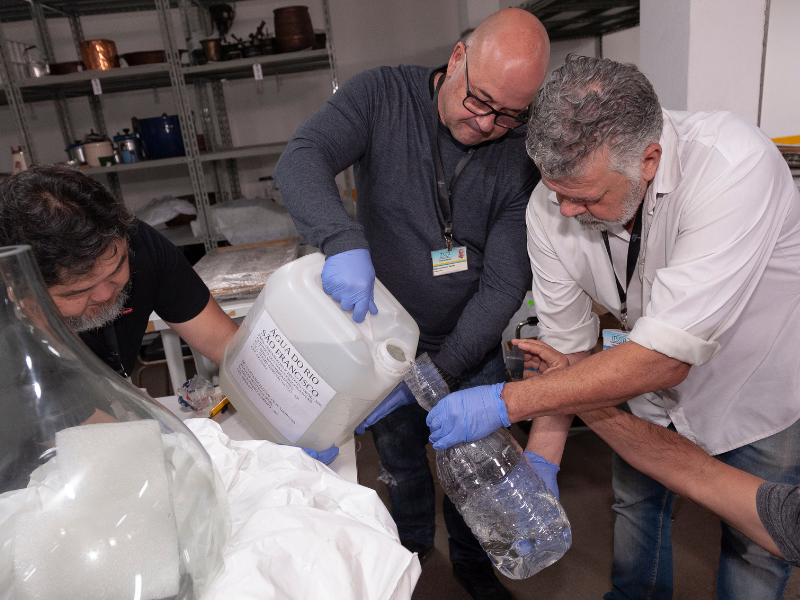
Regular cleaning of the collection is essential. Without it, time visibly accumulates.
In the late 1980s and early 1990s, libraries had many problems with bookworms and insects, which only ended with a continuous cleaning routine and work that started anew every day, book after book, from the first to the last, from the last to the first.
With this pattern, even fungi are on the verge of disappearing.
But the routine isn't that repetitive. Sometimes the need arises for a piece of furniture here, a stand for a water filter there – and we manufacture everything ourselves, from display pieces to office furniture, kitchen cabinets, whatever is needed.
I had no experience with wood and had to learn little by little. It's a very different material from paper – harder, more demanding. And while at the Ipiranga Museum I would just go to the carpentry team and say what I needed, at the Republican Museum of Itu I measure, cut, sand, and do the whole process, which completely changes the perspective.
And that's where another kind of pride emerges. When you walk into an exhibition and recognize what has passed through your hands, it's indescribable.
In the exhibition “The Republic on Stage”, we produced frames and supports, helped with the installation of the pieces, and resolved a lot of last-minute details, including even prints that came with errors and needed to be adapted right there.
The setup is the moment when time is lost and we stand for eight hours straight without even noticing when it's day and when it's night. But, when everything is organized in the space, there's this very unique feeling of seeing the finished product, knowing that you worked on it.
I still miss working with paper. There's something very special about being in a lab, applying techniques you know, closely following each stage.
The steps have something captivating about them: it's a process that demands attention and is built up little by little, at the pace of the material itself.
Although the work has shifted in its medium, not its logic. I continue to deal with structures, adjustments, with what needs to be done for something to remain and be seen.
Paper has become a thing of the past as a daily practice, but not as a point of reference. It's where everything started – and it's still through paper that I understand what I do.