
It all happened very fast.
In the same week, I had an interview, a medical exam, and I already started at the Ipiranga Museum.
The opening was for a cleaning assistant, and the person who interviewed me basically asked two questions: if I was willing to work in that field and if I had a problem with the commute.
I live in Cidade Tiradentes, East Zone of São Paulo, and Ipiranga is in the South Zone. From one point to the other, it's a three-hour drive.
I wake up at 3 AM every day, otherwise I'll be late.
I can't complain. Before I accepted this job, I lost count of how many resumes I sent out with no response.
I was unemployed for four years and supported myself by doing odd jobs. If I didn't see anything that could be considered wrong, I accepted whatever came my way. I worked at events, handed out flyers at traffic lights, and made tapioca and homemade cakes to earn some income.
It wasn't a lack of experience. She had already worked in laundromats, schools, and nursing homes. With the arrival of the pandemic, however, it became difficult to find any registered work.
So, when they called me for the interview, I was willing to do anything, and I wouldn't refuse any position or any region of the city. Still, on my first day, I didn't share this idea with anyone, but I thought I wouldn't stay long.
I had never been to a place like that before. I didn't know what a museum was; I had only seen them on television and hadn't had any opportunity to visit one.
At the same time, several things I saw on display reminded me of my childhood. When I looked at the main painting in the Grand Hall, with men on horseback wielding swords, I imagined my grandfather, who was a hunter and used to tell me about his adventures in the wilderness.
On the site where we lived, in Macaíba, Rio Grande do Norte, we had the same iron and the same dishes that I found in the exhibition “Houses and Things.” I remember to this day when I cleaned this room for the first time and relived my childhood. Moved by these memories, I even cried, being careful not to let anyone see.
I also really enjoyed getting to know Maria Leopoldina's painting and realizing that, despite all the humiliation and violence, she was a beautiful woman. I know her story with D. Pedro I wasn't easy – he was terrible – but I identified with her stance. We go through challenging situations, and we continue to be beautiful, put-together, and made-up so that no one can perceive what's behind it.
To this day, it still hasn't sunk in that I'm at the museum.
Suddenly, I was inside a monument. And now it's me who explains to others what this space is about. If they ask me, I say it's a place where a story is told about the people who lived before us in Brazil, like D. Pedro.
That's what I know, and that's how I pass it on.
When I arrived, I cleaned every corner of the building. The exhibition rooms, the stairs, the handrails, the staff room. And what we couldn't do in the presence of the public was left for when the museum was closed. Every Monday, for example, at least two of us dedicate ourselves to the red carpet. The guidance is to use a damp cloth and then dry it with a vacuum cleaner so it doesn't get moldy. It's time-consuming, but we manage.
The cleaning here isn't bad, it's just the little details. It's nothing compared to what I had to do in the nursing homes. There, when there weren't any elderly people needing care, the kitchen work piled up, and it was a huge hassle. Huge pots to wash, floors to scrub, and so on.
Today, I'm just in the restrooms. I prefer it that way because I'm an active person and don't like standing still. In this role, I'm always checking if any toilets are clogged, if there's no toilet paper, or if the trash needs to be emptied.
On weekends, a bit of everything happens: vomiting, diarrhea, menstrual blood. Some colleagues can't handle it, get nauseous, feel sick, and ask to leave, but I think I'm used to it. Sometimes something minor happens, and it passes quickly.
I'm already one of the longest-serving employees in my department, with five years here, and I'm often responsible for showing new hires the ropes. I explain that they can't use bleach on the floors because it stains. That water should be applied to the mop, not poured directly on the floor, and that the only exceptions to this rule are the balconies and bathrooms. The auditorium curtain, for example, just requires a white cloth and baking soda. If they use bleach or another product, it will stain immediately.
Here the cleaning is exceptional.
My salary isn't high. If I save, I can afford one little thing or another, like an ice cream or a chocolate. But I wish I could save more.
Sometimes I blurt out that I'm going to leave the Museum. And everyone replies:
“You are pleasant, don't leave.
Some even joke that I'm putting down roots, that I have a plant on my foot, and its name is “museum plant.”.
What I like most is how they treat me. In other places I've been, it wasn't always like that, and I never imagined I would be respected the way I am.
To give you an idea, I have low blood pressure. I decided to go on a diet and fainted twice in the middle of my shift. I'm being treated for it, and it hasn't happened again, but in both instances, I woke up in the hospital with my supervisors there with me. They didn't leave me alone and only relaxed when my son managed to get there to be with me.
I don't kiss up to anyone, but people like my work. I don't know if it's charm or what sweet thing runs in my blood.
Of course, if they transfer me, I wouldn't see a problem, as the last thing I want is to be unemployed again.
I also don't want to just stay in cleaning. I want to move up more.
One day, another employee came to tell me that I was educated and shouldn't be in this department. I was sad and felt undervalued, obviously, because it's the door that's open to me and I'm grateful for it, even though I want others to open up as well.
I finished high school during the first two years at the Museum. I would leave Ipiranga and go straight to school. It was a tough period, where I was tired and sleepy, but I never thought about giving up.
I have many dreams, I immensely want to be able to achieve them, and I feel that most of my colleagues lift me up. Some tell me to take a civil service exam, others say I can get a scholarship at a university, and there were even those who offered to pay for the course required in the security field.
“Wow, you're tiny, but you work a lot and you deserve more,” they tell me.
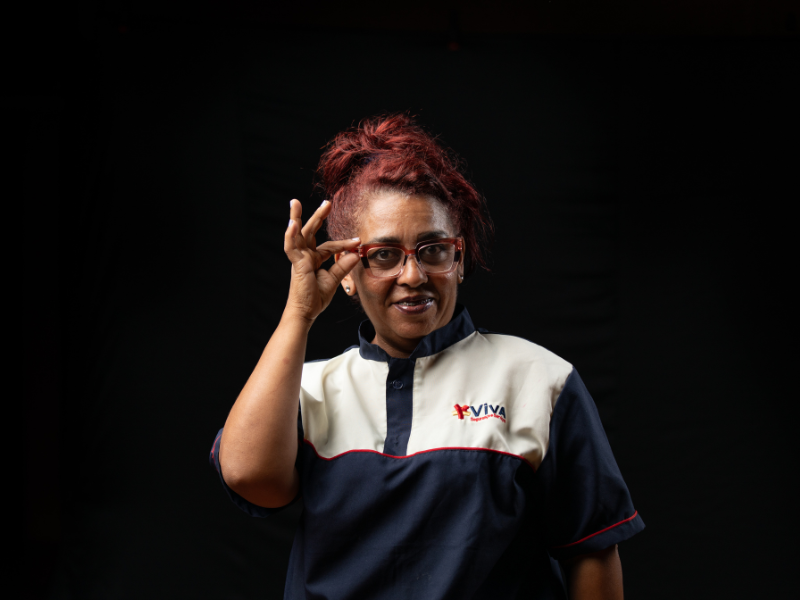
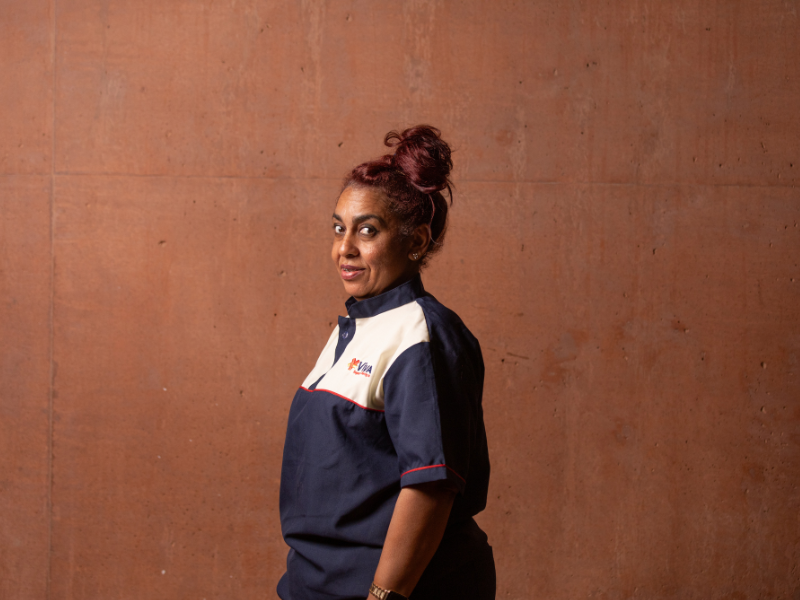
This is the first time I've had this support, and I think it's precisely what motivates me to stay at Ipiranga.
Whenever I have a little spare time, even just a few minutes, I go up to the Overlook to observe the immensity of the city.
Up there, I don't know how to explain it, but I feel such good energy that it makes me believe in life and keep dreaming.