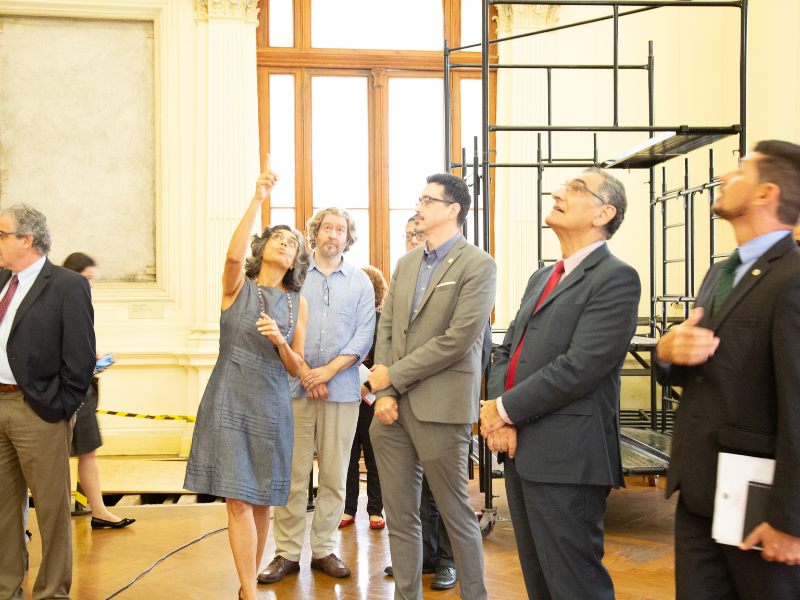
It was August 2013, and we were already planning for the September 7th celebrations. The situation was as follows: the central staircase and two rooms were cordoned off, stucco was falling, there was a risk of ceiling collapse, and rain inside the building.
There was nothing structural, but water infiltration with an old electrical system? It's a recipe for short circuits and fire. Exactly what happened to the National Museum in 2018.
At that time, I was the vice-director under Professor Sheila Ornstein, an architect from FAU who had taken over the museum's direction in 2012. Given this scenario, Sheila called me to tell me she had decided to close the doors to public visitation. My first reaction was to think about the employees:
“And what about the teams? Will they keep coming?” I asked.
If it wasn't safe for visitors, it wouldn't be safe for workers either. And anything that could fall on their heads could also fall on mine, the librarian's, or any other employee's.
Despite being the vice-director, when I questioned her, she was unaware of the consequences of my statement. I remember her expression as if it were today, which – I understood immediately – meant that I.
It happened overnight.
On Sunday, all employees were notified by message, and on Monday, we were already barred from entering the building. We held an emergency meeting at a neighboring address, which we rented as a support point. I think this was one of the most difficult days we all ever experienced at the Museum.
The decision was untimely and many considered it an exaggeration. On the other hand, I still believe today that if it hadn't been that way, the Museum would have remained open and we would have continued without an adequate solution until a tragedy occurred.
I don't know if another director would have had the same courage as Sheila, but she was from the Faculty of Architecture and Urban Planning, not connected to the daily life of the institution, its rivalries and vanities, and was extremely professional. Professor Sheila brought an external perspective to a very serious situation that, by being in it, we had somehow normalized.
Therefore, when I recall it, I get the impression that, as a museum lecturer, I was the one who had to deal with the chatter that we were exaggerating and that there was no reason for all the fuss.
I've always been a behind-the-scenes person and didn't get involved in politics. But suddenly, I found myself on the front lines, because it wasn't enough to close the doors for the problems to be solved. That was just a first step, a small step compared to the fact that, from that moment on, we needed to make the museum's renovation feasible.
The museum case spurred a political movement at the university. A movement aimed at changing the rules for electing museum directors! Restrictive rules that remain in effect – in museums, the election includes a body of voters that extends beyond the institution, unlike faculties and schools. The slates for museum director positions are elected by representatives from “related units” chosen by the museums themselves, in addition to the institution's Deliberative Council. These changes made the election for museum director less endogenous. As if museums weren't capable of deciding, like teaching units, who will lead the museum based solely on their collegial bodies. At.
The pressure for me to run was enormous, and I don't forget the day I presented my slate's ideas. Supported by my teaching colleagues (not all, but the majority), I defended vacating the building for the renovation, proposing to rent houses for the staff and for the transfer of the collection. The candidates from the opposing slate, who were outsiders to the Museum, thought it would be possible to do the work with everything inside.
It was totally unthinkable, and yet, I heard from colleagues that my proposal didn't make sense. I think that exaggerated reaction was associated with the fact that I am a woman. The other candidate was an engineer. I was left with the impression that the subliminal message was – leave works and matters of this type to engineers (men)... I was counting on Professor Rosaria Ono, whom I invited to be my vice director. Professor Rosaria is highly respected in the field of fire prevention in museums, and she fully supported the ideas I brought forward, which represented the desire of the majority of my fellow faculty.
When I won, it was a turnaround. It was unexpected.
We rented the houses, and used the funds from a Fapesp project for the collection's storage. Little by little, we proved that we knew what we were doing.
During my administration, I also managed to lay the groundwork for what I consider my main achievement, which was the creation of the Foundation for Support of the Paulista Museum, FAAMP. This was one of the items on the agenda for my term. The experience of the Ipiranga Museum building's closure had raised the alarm that it was not possible to depend exclusively on a single budgetary source – that of the University. And this awareness grew when I began to look at the successful teaching units of the University – all of them had support foundations.
So, ever since I knew I would be running for the position, I started studying management and read a lot about sustainability. It was clear to me that we couldn't rely solely on the University to solve all the Museum's problems because it was precisely that situation that put us where we were.
You know that saying about never putting all your eggs in one basket? The care not to have a single backup?
When I started presenting these ideas, the impact wasn't positive; I faced a lot of resistance. Some people even said I was trying to privatize the Museum.
A completely mistaken view. Because, in practice, the University would continue to support the staff and basic structure, but the Foundation would attract sponsors to enable other projects. And, in practice, this happened in several units. It just didn't happen in the museums.
It's curious to think that when I was a history student, my main interest was the city's heritage. I even did an internship for almost three years at the Department of Historical Heritage, and my role was to research properties of heritage interest to later nominate them for protection.
My life involved going to land registries to retrieve old deeds and compile inventories. I also went to the Ipiranga Museum frequently to consult the Aguirra Archive, which is an important documentary source on the territorial, real estate, and cartographic formation of São Paulo.
I got to know the Museum as a typical researcher, before I imagined that one day I would be fighting to keep it running.
In college, I thought I would keep working at DPH for a long time, but I ended up getting closer to Professor Ulpiano Bezerra de Menezes, who was one of the Museum's directors in the 1990s. It was during his tenure that the Museum stopped housing Archaeology and Ethnology collections to become a space dedicated exclusively to History and Material Culture.
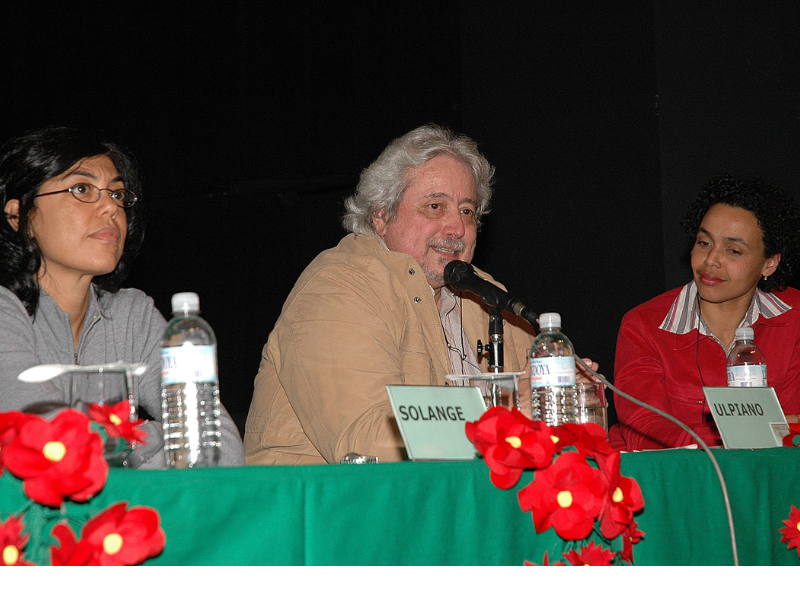
In History class, he was considered a reference and everyone was terrified of him. But he was a really important reference, especially for those who were working with heritage, as in my case, an intern at the DPH. So, despite the apprehension, I took advantage of the contact as a student and decided to invite him to be the advisor for the study group I was participating in with some colleagues. It was with his guidance, in fact, that we read the anthropologist Néstor García Canclini, or Mirko Lauer, and discussed the way Latin America mixes local traditions, erudite culture, and mass culture.
So, throughout this relationship, as soon as he took over as director of the Museum, he.
At that time, Ipiranga had many long-serving employees from other generations, and along with me, four or five other people joined. Looking back now, I think Professor Ulpiano took advantage of this characteristic to devise a plan and implement a new culture at the Museum, something we still carry with us today.
And what was the masterstroke?
He knew that no institution advances without a collaborative culture, because nothing works when people undermine each other. And, of course, like any public institution, there were power centers at Ipiranga. So, knowing this, the professor organized working groups with people from different departments and put us, young women, in charge of coordinating each one, because we were precisely the people who didn't know who liked whom, or who fought with whom.
Everyone became mixed together and the processes became more horizontal, as information began to be shared among everyone. And I think that was the secret to us being able to carry out all the surveys, to suggest acquisitions for both the library and the collection. Not to mention that, precisely during the period we entered, the Museum's management had decided to implement a database, and this led all areas to concentrate on cataloging the objects. Of course, this whole process involved moments of tension, in the relationships between those of the new generation and those who had already been at the Museum for decades. But I have more memories of the progress, because I think even those who were uncomfortable with the new way of working were able to sense that it could be beneficial for the museum. I don't know.
But regarding the database. Don't forget we were in the 1990s. Meaning, computerization was in its infancy, and we had a single computer to input data.
We worked like crazy, but it was very stimulating.
During this period, and for much of my life at the Museum—over 10 years—I held a position as a historian. However, in 2004, I decided to take the competitive exam to become a faculty member. The University was seeking ways to accommodate and regularize these functions within museums. There was the possibility of continuing as a researcher, but the faculty career had been implemented in museums the previous decade, a significant victory for museums. Working as faculty would offer more opportunities for growth.
The most memorable experiences I have, however, are not from the classroom, but from the time when my workplace was the Archive and Documentation room, with the technical team and many interns, students not only of History but also from different areas of USP. This has always been one of the museum's greatest assets: bringing together people, students or professionals, from different fields. As the Archive space was open to the public, it was also where people would come with items under their arms to donate.
In those years, a case that really impacted me was the visit of an elderly couple. They arrived with a collection of menus from the restaurant of a very posh hotel that was located next to the Municipal Theater. This gentleman's father had started there as a waiter, became a maître d' (manager), and even organized dinners for important politicians like Getúlio Vargas.
I remember thinking it was incredibly thoughtful of the couple because people don't usually imagine that something as ephemeral as a menu would be of interest to a museum, and I took the opportunity to check if they had family albums.
“Ah, we threw everything away. We don't have children and we thought no one would be interested in our lives,” they replied.
I was disbelief and got emotional, almost to tears, thinking they kept the menus and threw away the photographs.
During the same period, we were negotiating for the collection of a very traditional Lebanese family who were offering us copies of their albums. Naturally, we only expressed our gratitude, as we wouldn't accept anything that wasn't original, but when I met that couple, I realized how people from lower social classes don't believe their history belongs in a museum, while the elite understand this representation as completely natural.
It's the kind of thing that made me realize the extent of the responsibility I had, because when we're younger, we end up fascinated by extraordinary things, but over time, we see that what really matters is the public's expectation of the Museum.
The fundamental question is: why would someone seek out a museum to donate something? To be recognized. And I get emotional every time I think that the Ipiranga Museum can offer that recognition.
Very recently, we received the Nery Rezende collection, which is heartbreaking, because she became the largest collection by a Black woman, a worker in industry and commerce, and a single mother. And, before that, the Museum had nothing that could be considered a portrait of the Brazilian woman – most of what is in institutions bears the names of men. For a long time, they were the only ones who had the prerogative to be publicly recognized.
Therefore, I believe we are living in the best period for the Museum, and I find it amazing to think that in 2027, next year, I will retire, but I will be able to do so with the knowledge that I contributed to such an institution. And if there is one area where ageism is not so violent, it is teaching, because in this field I can retire and continue teaching or become a senior researcher, which is what I want.
I can't say yet what I'll study, and I confess I feel almost entitled to take a break. Because, for sure, a good portion of my gray hairs were born in these last few years. You can't empty an entire museum for renovation and watch a carriage being lowered by a crane without your heart leaping into your mouth.
Years of tension, fear, and extremely difficult decisions. But also of learning, courage, and collective building. The Museum is a very special place from the perspective of its teams. Starting with the faculty, my peers. It is welcoming. We are few, and we get along very, very well. The technical teams have known each other for years, and I've seen these teams change with new generations arriving. It's a privilege. The institutional culture that the Master Plan designed by Professor Ulpiano structured, way back in 1990, has managed to take root. Not without tensions, of course. Life as it is. But the overall result is very positive.
Today, seeing the living, open, and pulsing Museum, I have the feeling that every sleepless night, every doubt, and every confrontation was worth it.
Because, in the end, taking care of a heritage like Ipiranga is also taking care of people – including those who don't yet know they are part of this story.