I entered the Ipiranga Museum as if I were going to participate in a marathon.
We had nine months to set up 12 exhibitions, and I even started to think I wouldn't be able to do it because a task of that size would normally take at least two years.
Everything needed to take shape in time for the museum's reopening on September 7, 2022.
In executive production, I was at the center of this movement – coordinating people, processes, and deliverables, from graphic design to the minutiae of conservation.
It was a job that demanded presence on many fronts at the same time: from adjustments in image print tests to back-and-forth textual revisions, including scenography and items that, little by little, advanced on the assembly line.
Nothing was simple or quick.
Wall texts, for example, went through several hands: they started with curation, went to Education, who checked if the language was accessible, and returned for further validation before proceeding to review and translation.
It was crazy, but I didn't waste time.
I looked at my goals every day and bent over backward to meet them all within the deadline.
But in productions, unforeseen events always happen.
When we developed the exhibition designs and hired the firm that would develop them, something fundamental was left out: the design of the supports that would hold each item from the collection on the wall.
As soon as we realized, we rushed to negotiate the inclusion of these pieces in what had been agreed with the office. The answer, however, was negative. For them, it was a museum piece, and therefore it would be up to the Museum not only to design the supports but also to calculate the weight each one could sustain.
It turns out there were 4,000 objects.
Imagine my despair.
We assembled a task force, managed to design everything we needed, and after hearing many "no's" because of the tight schedule, we finally found a company that worked with us – they saved us.
I never forgot the excitement of that vendor at the opening. His company came from aviation, a distant territory from our universe, and he had never been to the Ipiranga Museum. But, on that day, it was his work that literally supported everything on display.
I kept this image because when I saw his face, I remembered myself.
I come from a family with no resources. Throughout my childhood, I had a single pair of sneakers to wear year-round. If I stepped in a puddle, I'd return to school the next day with them still damp.
There were times when we had nothing more than bread, coffee, milk, and margarine, and at afternoon snacks, we invented different ways to prepare these ingredients so we wouldn't get tired of eating the exact same thing every day.
Bread with margarine dipped in coffee.
Coffee with milk soup and chopped bread.
Bread, margarine, and coffee filling.
My mother didn't finish seventh grade, and my father completed elementary school through a program for adults. In my family, I was the first to go to college, on a scholarship for Advertising and Marketing.
The first two years were great. I had Sociology, Photography, and Art History. But as we progressed to more specialized subjects, I started to feel like I wouldn't have chosen this course if I had had some career guidance.
One day, in class, we had a big debate about the function of marketing. The professor challenged us: did our profession meet existing needs, or was it responsible for creating those needs itself? The class was divided, and all I could think was: what am I doing here? Of course, marketing created needs.
I looked at the entire class's involvement and remembered my own story.
How, coming from where I come from, will I be able to stimulate consumption and dedicate myself to everything I consider superfluous?
But life finds its ways. In the course of the semester, I ended up talking to a history professor who needed someone for the projects area of the São Paulo State Public Archives.
I lived in the far South, in Jardim Ângela, and the Archive was in the North Zone. I crossed the city to work there, and on the long commutes, books kept me company. That's where I found myself, writing projects to manage archives, sanitize and conserve documents, digitize them, and so on.
When I arrived at Ipiranga, I had already spent years at the State Archive and gained experience both at the Museum of Energy, in project development, and at the museum unit of the Secretariat of Culture, where I oversaw management contracts related to 19 state museums.
Little by little, I acquired a deep knowledge of Museology. I dealt with a broad universe: it ranged from the Museums of the Portuguese Language and Football to the Pinacoteca of São Paulo, then moving on to institutions in other states.
It was years of diving into this area, understanding what it meant to care for historic heritage spaces with the potential to transform people's lives.
When I found out about the opening at Ipiranga and went for the interview in 2019, I realized I had solid experience in structuring and managing tender processes, but I had never worked on producing an exhibition – exactly what the position required.
Would it be enough?
Despite the doubt, I faced the challenge, as I always had. And only later did I realize the magnitude of the responsibility I had taken on.
To complete this mission, I went through two difficult moments in my personal life: the pain of losing my in-laws, who passed away from Covid-19 in March 2021, and in the same year, my husband passed a civil service exam for a position in Acre, which he was to start in the museum's opening year.
A big conflict.
At the same time, while he couldn't refuse the position, I also had no way of leaving the Museum at that moment. It had been a struggle to structure the projects, follow all the steps, and produce everything to see the Ipiranga functioning. It made no sense to leave the job precisely at the implementation stage of what I had been dedicating myself to in recent years.
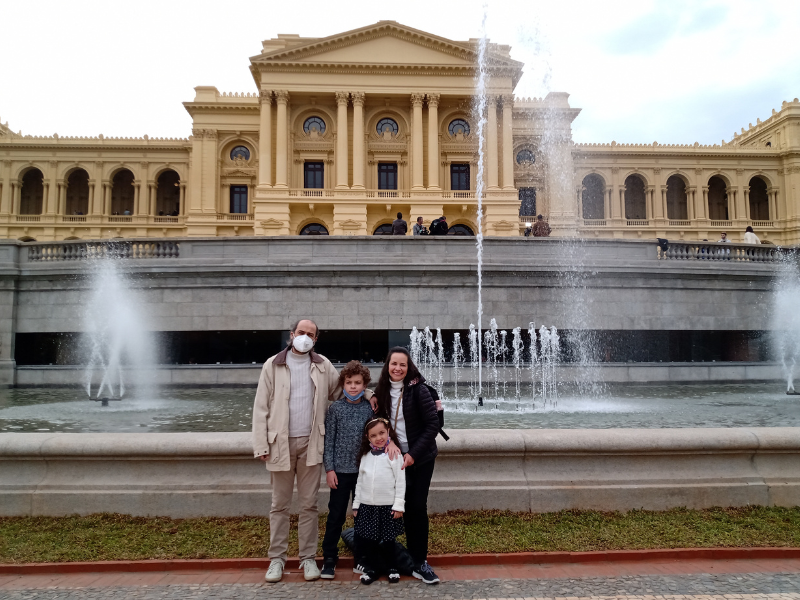
In the end, my husband left and I stayed at the Museum, alone, without a support network, with my two children. Antônio Pedro was 10 years old and Alice was only five.
It was the project of my life; I could never abandon it.
Everywhere I've gone, I've always found fulfillment.,
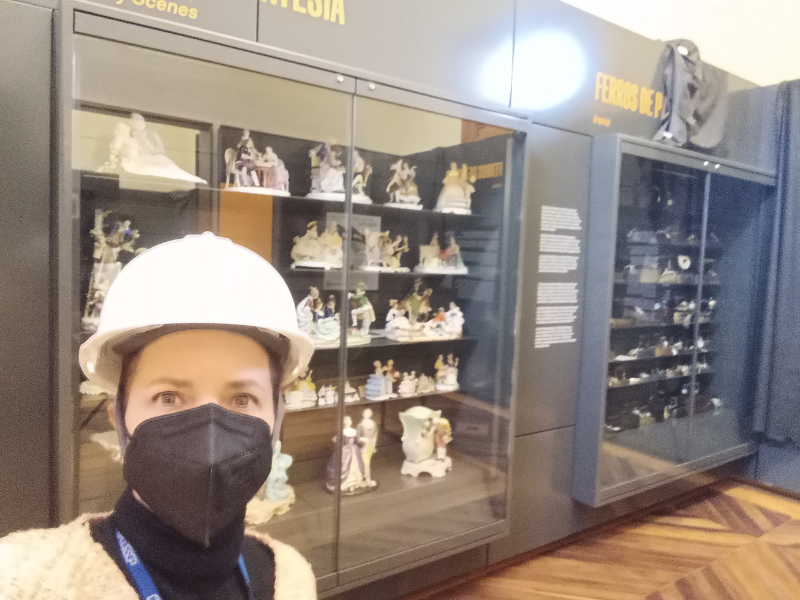
but nothing compares to what I experienced at the Museum. At the Department of Culture, the responsibility was immense, managing a budget of around 100 million per year. Still, Ipiranga was the grandest achievement of my career.
On opening day, I was overcome with a feeling of pride that I had never accessed before, and I couldn't stop repeating to myself that I had done it.
Then, when the emotion settled, and I was finally able to observe my surroundings, the biggest surprise was seeing my children there, curious and amazed, discovering from an early age the feeling of being in a museum.
I didn't have that opportunity.
In the public school I attended, museums weren't even part of the vocabulary. Field trips were limited to the Zoo, the amusement park, and the Coca-Cola factory.
It was only at 15 years old, already in technical school, that I first entered the Museum of Image and Sound, when an Art teacher encouraged us to see an exhibition about the history of advertising.
I don't know how to explain it, but there I understood that there wasn't a single way of looking at the world. I learned that I could “research.” In the end, I think museums are these spaces for displacement, where reality expands and we see beyond what we're used to. Of course, I did research for school assignments, but it was in a museum that it truly made sense.
How amazing to have access to all of this.
That's why, if today I am in a long-distance marriage with my husband more than 3,000 kilometers from São Paulo, and I have to deal every day with how much I miss him and how much the children miss him, it's because I have Ipiranga as part of me – something inseparable from my identity.
The museum is my life's work. Every time I'm here and see the faces of the students – many stepping inside for the first time – I feel I've chosen the right path.
And I hope the same thing happens to them that happened to me.