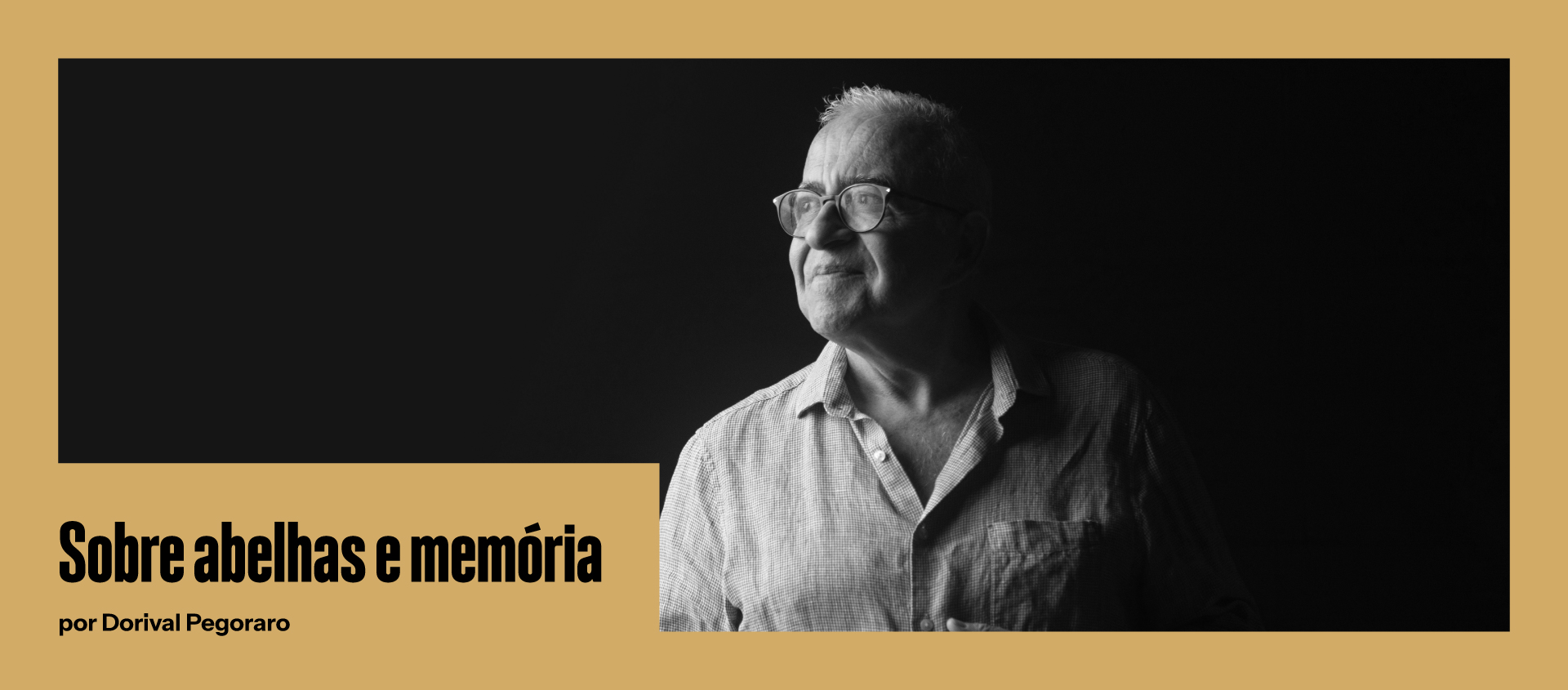
To me, the Ipiranga Museum smells of honey.
Ever since I was very young, I followed the day-to-day work of my uncle, Lúcio Pegoraro, who was the institution's sole restorer for over 30 years. I remember him bent over a single canvas for days on end, working meticulously, applying beeswax to reline it – a delicate gesture of applying a new fabric to the back of the original painting.
Through his hands passed paintings by artists such as Benedito Calixto, Oscar Pereira da Silva, and, of course, Pedro Américo's masterpiece. He worked in a room inside the building, and I, as a child, watched his craft with awe; the aroma of honey spreading through the corridors.
It's been 35 years since my uncle stopped working at the building, but, even so, my sense of smell still recognizes the aroma.
As if time had stopped.
Perhaps it was that persistent smell that brought me to the Museum, where I began working through Lúcio's influence and, thanks to him, became the dean of the house, with almost 50 years of dedication.
Before, I worked in billing for a car company. I started at 15, and by 18, I was completely burned out. I worked myself to death, got paid very little, almost nothing, and I started dreaming of a more peaceful environment.
I knew I was young and that, in a multinational company, I had my whole future ahead of me. On the other hand, the idea of working at the Museum also meant being around not only my uncle, but also my aunt, who was the institution's secretary and like a second mother to me.
And there was also daily contact with the collection and with the building itself, with its wide corridors, stone staircases, and high rooms, which always caught my attention.
That's how I ended up following my family's advice and signed up for the competition. Back then, the competition wasn't as intense as it is today, and I managed to pass.
I remember the atmosphere back then was much calmer. The stress and arguments, strangely enough, were concentrated around the fax machine—a territory disputed almost by brawling.
It was the pre-internet era, and I did everything myself. I'd sit with the curators to understand the exhibitions, produce and distribute the press releases, accompany journalists for interviews, film shoots for television, and then I'd still organize the clipping with all the news that had come out.
I could handle things in my thirties and make them work. That is, of course, unless I needed authorization to use the Museum's only fax line.
Imagine. It would be the equivalent today of a communications employee having to ask permission to access the internet. And that's exactly what the assistant director wanted me to do: I would only have access to the device if the director himself allowed it.
“For God's sake, release the fax!” It was a common phrase in my daily life.
It's a reality that doesn't compare to what we have now, with several employees splitting up to perform tasks and meet journalists' demands. And despite that, I've accomplished a lot.
When we organize the book Face of São Paulo, In 2013, we reviewed the main news stories over 50 years, considering the entire history of the Museum since its incorporation by the University of São Paulo. It wasn't easy to make this selection, as we had over 1,800 reports, many of them full-page and even newspaper covers.
It was almost a crowning achievement for my work.
In this context, I will never forget the period when the Ipiranga Museum closed due to leaks and the risk of ceiling collapses. The interventions were urgent, and the management, as expected, faced difficulties in obtaining the necessary resources.
That's when I had the idea to call the newspaper The State of São Paulo, because I was sure that a high-profile report would attract the attention of sponsors and the University itself. I remember that, at first, Sheila Ornstein, who was our director, was hesitant, asked to think about it, but there was no other way.
As soon as we did the story, I had the feeling of having thrown a bottle into the sea – and of finally seeing it be found. Before long, USP volunteered to assist us and formed a working group to tackle the Museum's situation.
Just thinking about how happy it was still moves me, because it wasn't uncommon to hear criticism that I didn't know what I was doing and that my work was “homemade.” But it was precisely this homemade character – done well, with care and love – that allowed things to progress and be resolved.
My background is in Literature, not journalism, but I think I did a job worthy of it.
I feel the same way about my uncle, who made a brilliant contribution to the institution and, yet, is sometimes questioned.
In his time, beeswax was commonly used to reinforce fragile canvases, fix paint layers, and reline entire works. Over time, however, the technique fell out of use, primarily due to the material's sensitivity to heat and the difficulty of removing it without causing damage to the original.
Today, of course, technology has advanced greatly, and there are synthetic resins that are more stable and easier to remove when needed. But this does not diminish my uncle's dedication, who gave his life for these works. The canvases with which he worked, in fact, remain.
Only with Independence or Death, for example, he spent more than six months. And whenever I look at this majestic screen, I think about how the “feared” beeswax preserved it to this day. And thanks to my uncle's dedication.
We both lived through another phase of the Museum. I've been here since 1979, and I arrived at a time when the institution was still encyclopedic, with pieces of archaeology and ethnology.
When I joined, I had the opportunity to closely follow the work of Luciana Pallestrini, who was one of the greatest exponents of archaeology, alongside Niède Guidon. While Niède dedicated herself to rock paintings in Piauí, Luciana created the Paranapanema Project and conducted numerous studies in the state of São Paulo, where several archaeological sites were identified.
When I was young, I took on the role of secretary, answering phones and assisting with cataloging the artifacts. Little by little, however, I became a sort of apprentice and started accompanying the team on some expeditions. I was at Lake Ypacaraí in Asunción, Paraguay, and also in the interior of São Paulo, where I assisted with the first excavations for the collection of objects. It was manual labor, but rewarding, especially when the first archaeological evidence emerged: pottery fragments, skulls, and even human skeletons.
With Luciana, I got to know many worlds. And I say that not only because of the trips I was able to take, but also because of the researchers she recommended to me, since, in addition to my duties at the Museum, I did odd jobs as a typist.
And it wasn't just any material: they were master's theses and doctoral dissertations.
Thus, I learned continuously. It was how I learned more about cave paintings and engravings, lithic objects, and sambaquis, which are pre-colonial archaeological sites formed by the accumulation of shells and fish remains. I even typed a thesis in Tupi-Guarani.
Today, with computers, it's possible to correct errors and insert new data with ease, but back then, a single error could compromise everything. You had to start over from scratch, typing every word on an entire page again.
I was fascinated by the culture of prehistoric man and, for a moment, considered studying Anthropology. But then, when that collection was transferred to the Museum of Archaeology and Ethnology at USP and the Ipiranga Museum turned its focus to the History of Material Culture, I realized my decision to study Letters was the right one. That's how I managed to contribute with advisory services.
It happened naturally, because it was something I already enjoyed. I was always very shy, but when I had to talk to a journalist, that shyness would simply disappear, and perhaps that attitude helped to solidify the Museum's relationship with the press.
Thus, when the building closed and the Foundation for Support of the Paulista Museum was created, taking over press relations, the institution's bond with all media outlets and journalists was already solid.
It was then that, once again, I ended up taking on a task that no one wanted all by myself.
The younger generation says it's a boring job, but I know it's essential. I handle the agreements, the project loan area, and image management. It's extensive paperwork, consisting of reports, insurance, and authorizations. If even one document is missing, nothing gets done.
Now, between 2026 and 2027, we will also have to renew all the image licenses used in the exhibitions, as the usage authorization is valid for five years. This is no small matter: there are over 600 images, from about 140 institutions, and they are distributed across videos, panels, and promotional materials.
That's why most people don't like this feature, but I, on the contrary, love it.
Sometimes, of course, that tiredness hits, which is natural. I also faced a tumor recently and needed to take care of myself.
Today I'm doing well, I'm strong, and I like to say that I'm an old man with the energy of a young person.
Time flies, but I keep going with the same energy as before.
I am 67 years old and can remain at the Museum until I am 75. I don't know exactly how long I will stay, but I still have a few years ahead of me.
What I know is that a part of me will remain here even after I retire.
It's the stories I helped put in the newspapers, the exhibitions that resonated around the world, and the smell of beeswax that, even today, seems to linger in the walls.
There are things that time doesn't take away – and that no one can take from us.