I hadn't even been at the Republican Museum of Itu for three months and I thought I was going to be fired.
I had just turned 18 and had no idea what working in a museum was like, much less what the role of a documentation technician meant. When I heard about the competition, I applied on impulse, driven more by the desire to be independent and have my own money than by any real understanding of what it actually entailed.
It was only in practice that I began to understand what it was like to be a public employee in a library at a museum institution.
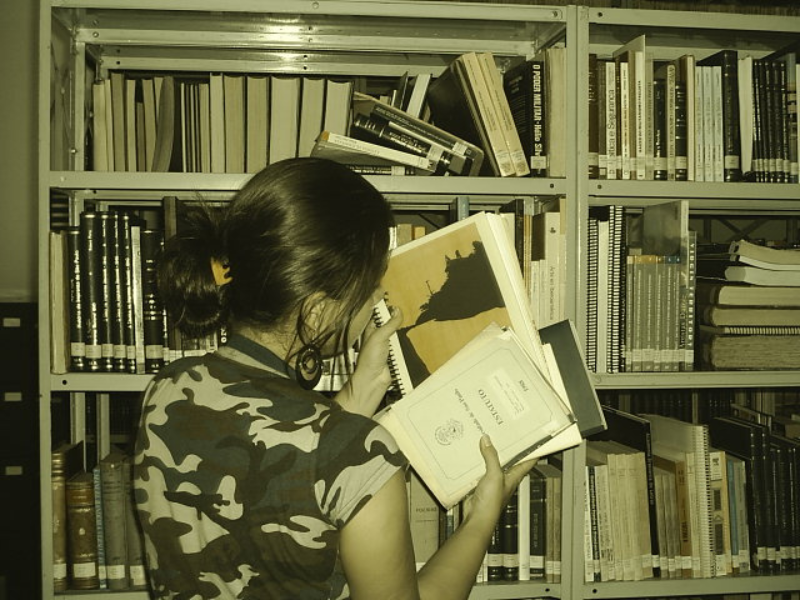
My first job was to apply barcodes to the entire Prudente de Moraes collection.
The publications were kept inside the museum, in an office with antique furniture: a heavy table and wooden chairs that seemed unable to bear any weight.
I spent my days standing, resting the books on the worn surface of the table. Hours were spent repeating the same gesture, label after label, until my body began to give out. The end of the workday was approaching, and I noticed a chair a little further away, looking sturdy, and the promise of rest overcame my excessive caution.
I sat down. The straw immediately sank, as if it had been waiting just for me.
I was startled, and before I could recover, guilt washed over me, as I soon realized it wasn't just a chair I had just broken, but something that discreetly bore the initials of Prudente de Moraes.
I was so nervous that I started praying! I went to the supervisor, trembling, almost completely certain that I would be fired. But, luckily, she made a few calls, and the restoration team ended up taking the blame.
The trauma was so great that, to this day, I haven't gone looking for what happened to that chair – and it's been twenty years.
Before entering the museum, I imagined the library as a place of silence and the librarian as a sort of teacher, always available to impart their knowledge to anyone who came seeking research.
The reality, however, was different. My contribution was largely reduced to mechanical and manual tasks. And I had barely recovered from the exhaustion imposed by the Prudente de Moraes collection when I was already facing another job: the listing of Professor Edgard Carone's publications.
There were 27,000 books and a single mechanical stamp to number the entire collection. As if that weren't enough, the device was old, worked poorly, and required disproportionate force, more ink than it should, and extra attention to prevent excess from spreading across the pages like an irreversible stain.
In addition, many books arrived covered in a fine, whitish dust. Only later did I discover that it was hexachlorocyclohexane, a toxic insecticide, now banned.
The result was acute allergic rhinitis that became chronic, and which not even a mask could contain.
I worked six hours a day, I attended college at night and continued without pause. Still, constant contact with books opened other avenues: with each page turned, a curiosity arose that I pursued during my lunch break.
Lee The Capital, by Marx, and a multitude of texts on dictatorship, but also etiquette manuals and travelogues. It ranged from publications with images of torture and injured faces to detailed descriptions of the correct way to use cutlery and napkins, or the necessary precautions for hosting dinner guests.
It was always like this – one book leading to another. “This one is interesting,” I'd think. “I want to see it better.” And, little by little, they'd pile up on my desk.
Still, after a few years, I was already thinking about giving up. It wasn't that I didn't like what I did. On the contrary, I liked it, but I felt undervalued with purely mechanical tasks while I wanted space to think and develop deeper reflections. And that changed as soon as I was able to migrate to the documentation area and, later, to iconography.
As soon as I started, I realized that the cataloging there followed a logic distinct from the library's, where each item was treated individually. In documentation and iconography, work was often done by sets: groupings whose content remained partly unknown, since the items that composed them were not always actually listed.
So we had about 6,000 minimally described pieces, and alongside them, another 15,000 items about which almost nothing was known. Therefore, I took on this task and started opening box by box, with meticulous attention, describing and specifying what until then had only been suggested, like something you have a vague idea of.
I once assisted a client who was looking for a photo of the town square. He needed to reconstruct the facade of a house that had been demolished and was looking for some reference of what it had been. We searched and searched, but found nothing. Only later, with the reorganization of the archive, did the image appear. Too late: the house had already been rebuilt and, in the end, bore little resemblance to the original. They did what was possible with what they had – and we, at that moment, could not help.
It's been almost four years reorganizing the collection, and it's in this task that I've invested all my knowledge. It's not just about listing them haphazardly, but about inscribing each item within a system that allows it to be found by others, after me.
If I don't come in tomorrow, someone needs to be able to pick up where I left off.
It's still partly manual labor, but interspersed with a lot of research. And it's at that intersection that things start to emerge.
In the beginning, what I knew about the Museum was the basics. Nothing more than that it operated in the two-story house where the Itu Republican Convention took place in 1873, and that this meeting was the origin point of the republican campaign and the Paulista Republican Party.
It was the essentials learned in school. But when you start consulting the archives, that initial outline soon dissolves and other layers emerge.
In this process, I surveyed the collection, which includes photographs of the delegates – the participants of the convention. They were donated to the Museum and used as the basis for the paintings on display, such as those by Tarsila do Amaral and Oscar Pereira da Silva.
These are images we've seen so many times that names have become fixed to them. Still, as I looked through them once more, I found a photograph that stood out: that of a Black man, unidentified, without any reference. A nameless presence.
And then the questions arise. Who was he? Why wasn't he identified? Could he have been one of the delegates? What is this record doing here?
Still, in the 1870s, slavery persisted in Brazil. So, would it be possible for a Black man to be among them?
We do not have this answer.
And it's at this point that the work is extended, as the cataloging doesn't end the questions but expands them. It's where the information is gathered, organized, and supported, so that others can then build upon it.
As soon as I started at the Republican Museum, there were two surprises. The first, the connection between the Itu Museum and the Ipiranga Museum, which together form the Paulista Museum. The second, the discovery that both were administered by the University of São Paulo.
Later, then, I recovered the memory of the first time I was at Ipiranga.
It was a busy day on a school trip: we also went through Ibirapuera Park, the Museum of Zoology, and walked through Independence Park. But what remained was that feeling of not being able to grasp everything at once and, above all, curiosity about the people who worked there.
One thought wouldn't leave my head: “What do you need to study to work in a museum?”.
In the end, I studied electrical engineering – a field I never actually worked in – while I got closer to images and cataloging, which ended up taking another place in my career path.
I am very proud of what I have learned over these years, because I see a wealth of knowledge built little by little, with effort, and which involves both the conservation and organization of the collection.
Therefore, I usually introduce myself like this: “I work for the Republican Museum of Itu, for the Paulista Museum, and for USP.”.
I'm not a teacher, nor am I directly involved in knowledge production, but I've worked at a public institution for almost twenty years. And it's in this place that I recognize myself today: as someone who participates, in her own way, in the construction of collective history and memory.