Online course
Dates: December 16th and 17th (Monday and Tuesday)
Time: from 6pm to 9pm
Workload: 6h
Job openings: 500
Location: The course will be held in a virtual environment, through the Ipiranga Museum's profile on the YouTube platform.
Free registration: From 11/21 to 12/11 in this link. Teachers and students must complete the registration form at the provided link and send a copy of their institutional affiliation document via email: apoioacadmp@usp.br.
Information: e-mail: suporteacadmp@usp.br, tels. (11) 2065-8075/6644
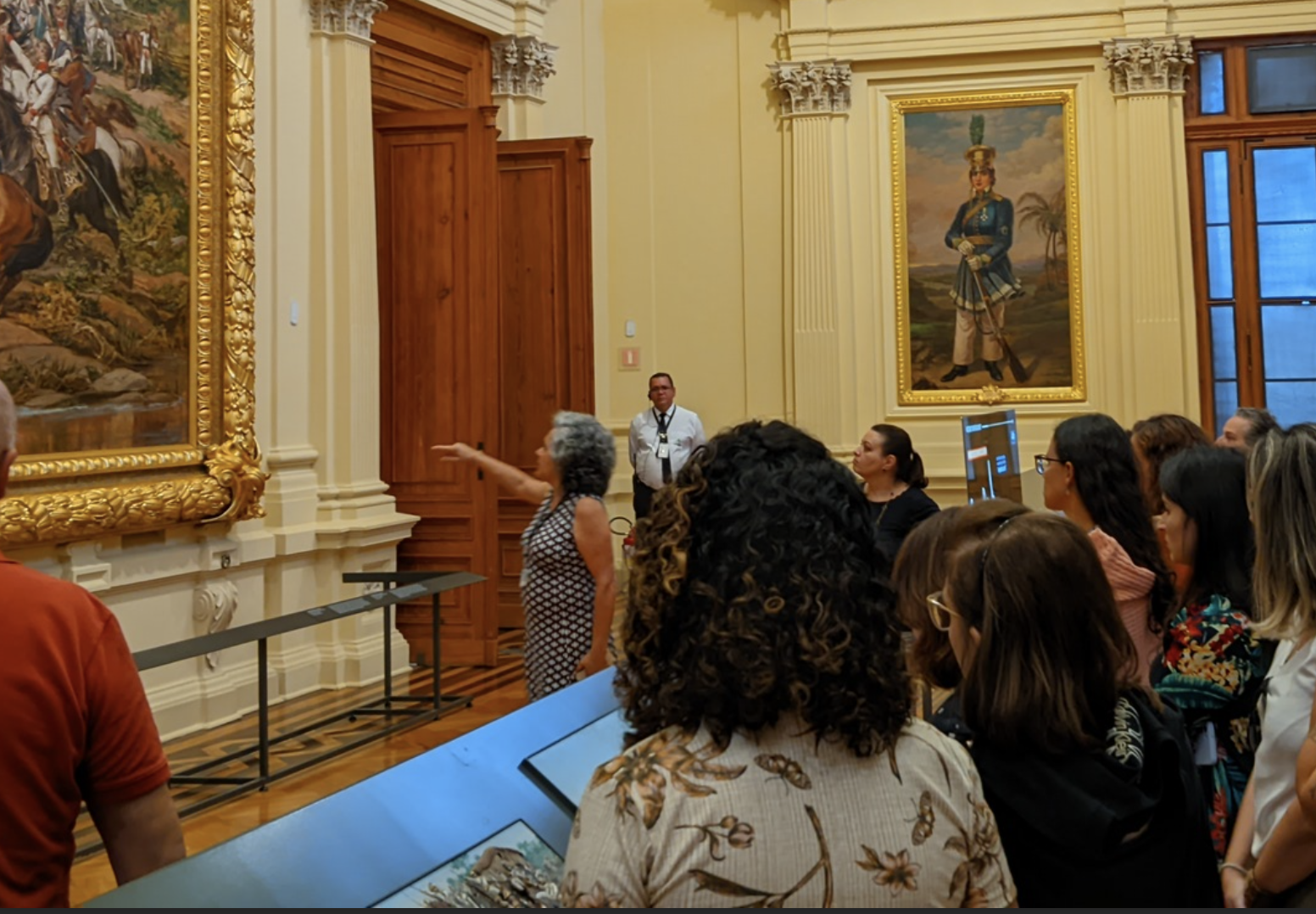
Educational Curatorship is an approach that positions education as a central element in mediating between the public and cultural heritage. At the Ipiranga Museum, this perspective seeks to create meaningful and accessible experiences, promoting dialogues between visitors, exhibitions, and collections, based on inclusive and participatory practices.
It is in this context that the institution promotes the course. Educational Activities at the Ipiranga Museum. The objective is to empower educators and professionals interested in the field to develop educational practices aligned with the guidelines of heritage and museum education. Based on contemporary theoretical and practical reflections, the course will address methodologies that consider the diversity of audiences and broaden access to cultural heritage, promoting enriching experiences in the museum space.
The classes will discuss topics such as mediation strategies, accessibility resources, the development of teaching materials, and the importance of continuing education in a university museum. Participants will have the opportunity to delve deeper into the role of education in museum spaces and contribute to the democratization of cultural access.
The classes will be held remotely, with live streaming on the Museu do Ipiranga's YouTube channel. To receive the certificate, students must sign the attendance list on both days of the course.
Presenter: Laura Stocco Felicio
Program:
1. The educational program of the Ipiranga Museum: its structure and key concepts
2. Different audience profiles and mediation strategies
3. Accessibility resources and the role of education
4. Development of teaching materials
5. The importance of continuing education in a university museum.
6. Evaluation and reflection on practices